Drone Strike: Gunship War
VNGGames StudiosAction
4.554.00 Reviews
- Version
- 1.7.1
- Installs
- 100.00K
- Age Rating
- Teen
Screenshots
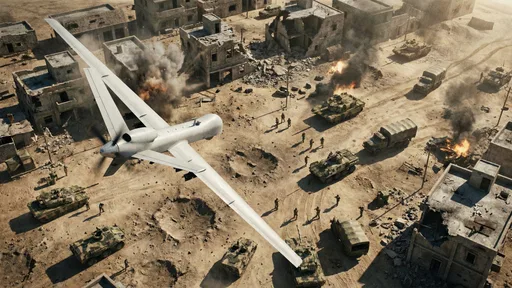
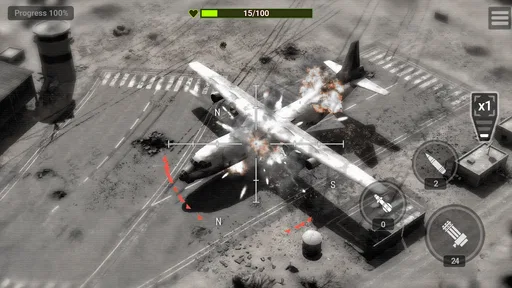
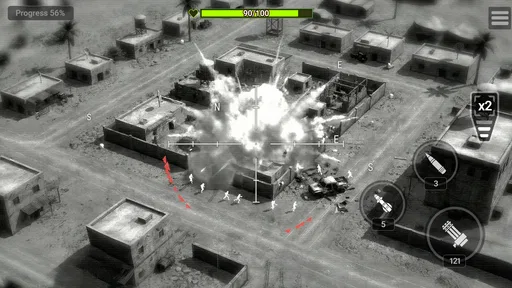
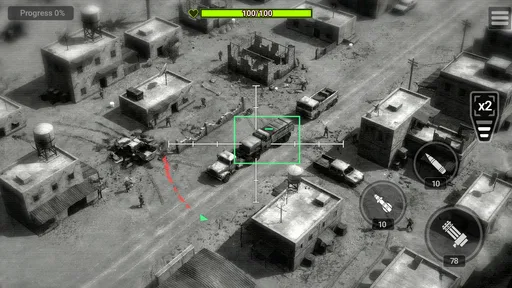
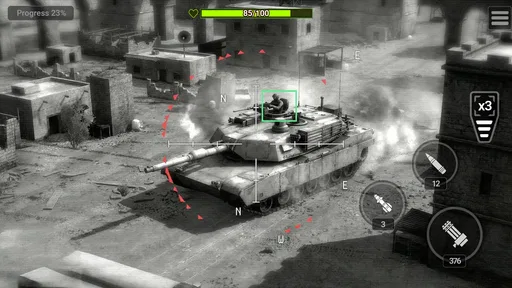
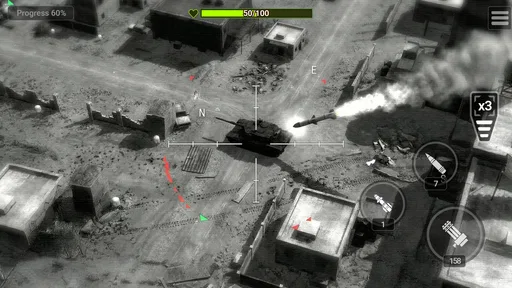
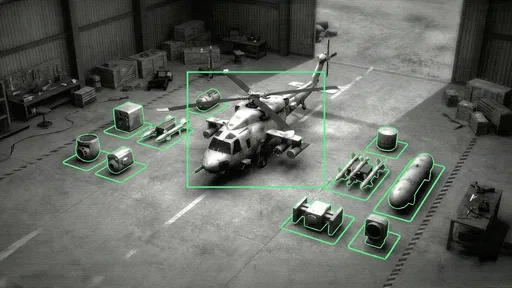
Our Review of Drone Strike: Gunship War
 Analysis by Appyee
I spent time with Drone Strike: Gunship War as a mobile action game built around directing AC130 gunships and war drones from a touch screen. Its basic appeal is easy to understand: choose a target, line up an attack, and try to turn a chaotic battlefield into a controlled strike. That sounds simple, but the experience depends heavily on how comfortable you are with quick decisions, repeated combat, and the visual pressure that comes with an aerial shooter.
My first impression was that this is designed for players who want an action game they can understand quickly rather than a long, complicated military simulation. VNGGames Studios keeps the central idea focused on aiming and striking. I did not need to spend a long time learning a fictional world before getting into the action, which makes it approachable when I only have a short break. At the same time, the straightforward premise means the game has to rely on the quality of its moment-to-moment decisions to stay interesting.
The game is free to download, with optional purchases ranging from $0.99 to $99.99 per item. It carries a Teen content rating, so I would not treat it as a universal game for younger children. On the store, it has a 4.5 average from around 1.8 thousand ratings, while its reach has passed 100 thousand installs. Those figures suggest that it has found an audience, but they do not replace personal testing: the real question is whether its pace and shooting style fit the way you like to play.
How the action feels from the first strike to longer sessions
I focus on what happens between choosing a target and deciding whether to begin another round: the game’s appeal rests on that compact sequence, not on elaborate setup. I’ll look at how the AC130-and-drone premise shapes the first attack, then follow the feedback and rewards that can make a brief session feel satisfying—or leave me ready to put the phone down.
Quick access, but not necessarily a shallow experience
The biggest advantage is how quickly the concept communicates itself. You are not asked to manage a large collection of unrelated systems before understanding the main purpose of the game. The gunship and drone focus gives every encounter a clear identity, and the aerial viewpoint helps the action feel different from a typical character-based shooter. If you prefer games where the objective is visible and the controls are built around directing fire, this is a more natural fit than a large role-playing game with many menus.
I found the expected pace most appealing when I treated each session as a short tactical exercise. The satisfaction comes from recognizing where pressure is building, deciding what deserves attention, and making the strike before the situation becomes harder to control. That rhythm is more rewarding when I stay alert. Playing while distracted makes the action feel less precise, because the game’s appeal is tied to responding at the right moment rather than simply holding a button and waiting.
One useful habit is to pause mentally before every attack, even when the screen looks busy. Instead of reacting to the most obvious target, I look for the threat that could create the biggest problem if left alone. This small change makes the game feel more strategic without requiring a complicated planning system. It also helps prevent wasted attacks, which matters in a free-to-play game where efficient play can be more satisfying than rushing through every encounter.
What changes when the screen becomes busy
The experience becomes more demanding during heavy-use moments, especially when several visual elements compete for attention. Aerial action can look impressive, but that same viewpoint can make it harder to read the battlefield instantly. I sometimes found myself choosing between a target that was easy to see and another that seemed more important. That tension is a genuine part of the game’s challenge, although it can also feel frustrating if you prefer perfectly clean visual information.
My advice is to avoid treating every target as equally urgent. The most effective workflow is to scan first, identify the immediate danger, and only then commit to an attack. This is more reliable than tapping quickly at whatever appears closest to your finger. It also gives the game a stronger tactical flavor, because the player’s judgment matters as much as speed.
Longer sessions reveal a trade-off. The focused shooting loop is convenient, but repeating similar decisions for too long can reduce its impact. I enjoyed it most in compact bursts, where each attack still felt deliberate. Players looking for a deep campaign with constant changes in scenery, story, or character development may find the structure less satisfying than a larger action title. Players who enjoy repeating a clear combat loop and improving their own decisions are more likely to appreciate it.
How demanding it feels on a phone
Because the game uses gunships, war drones, and battlefield effects as its visual identity, I would expect it to feel more demanding than a very basic puzzle game, particularly when the screen is crowded with action. I cannot responsibly turn that impression into a specific battery, memory, or frame-rate claim, but the practical lesson is simple: keep other demanding apps closed if your phone is older, and avoid judging the game during the first few seconds after launching while the device is still busy with background tasks.
The minimum operating-system requirement is Android 6.0, which makes the compatibility barrier relatively broad for Android users. That does not guarantee identical performance on every phone. A newer operating system can still run on hardware with limited memory or modest graphics capability, so I would pay attention to heat, touch response, and stability during a longer play period rather than relying only on the operating-system requirement.
On a stronger device, the aerial perspective should have more room to breathe when several effects appear at once. On an older phone, reducing the length of play sessions and allowing the device to cool may be more useful than expecting the same smoothness as a recent model. If your priority is the lightest possible game with minimal resource demand, this is probably not the safest choice in the action category.
Stability, recovery, and the practical side of playing
Reliability matters more in a game built around short attacks than many people realize. If an action game interrupts a session, loses responsiveness, or makes recovery awkward, the problem is not only technical; it breaks the timing that makes the combat enjoyable. My approach is to begin a session with a stable connection and enough free attention to finish the current encounter instead of launching it in the middle of another task.
I also recommend restarting the game if the phone has been active for a long time and the controls begin to feel less responsive. That is not a special feature or guaranteed fix, but it is a sensible mobile habit when a game contains animated combat and repeated touch input. Keeping the operating system current and leaving reasonable storage space available can also reduce general phone friction, even though those steps cannot guarantee perfect behavior.
Recovery is especially important for casual players. If you are interrupted by a message or need to put the phone away, you will want to know whether returning to the game feels natural rather than stressful. I found the best way to handle this kind of title is to play when I can give it a few uninterrupted minutes. It is less suitable for moments when I expect to switch constantly between the game and other apps.
The current version is 1.7.1, so the game is not presented as an untouched launch build. That gives me more confidence that the developer has had time to refine the experience, but I still avoid assuming that every device will behave identically. Version information tells me what build I am using; it does not tell me how smoothly a particular phone will handle busy combat.
Where the free model affects the decision
The free entry point is helpful because I can try the central shooting loop without committing money first. That is exactly how I would recommend approaching it: install it, play enough to see whether the targeting rhythm feels satisfying, and only then decide whether optional spending is worthwhile. The purchase range is wide, from small items to much larger ones, so players who want strict control over their budget should review each purchase carefully before confirming it.
This model can change how enjoyable the game feels for different people. Some players are comfortable treating optional purchases as a way to support a game they already enjoy. Others dislike seeing any spending pressure in an action title and would rather pay once for a complete experience. If you belong to the second group, a premium action game may be a better match, even if it has a higher upfront cost, because its business model may feel easier to understand.
I would also avoid buying anything during the excitement of a difficult encounter. First decide whether the purchase improves a problem you genuinely enjoy solving or simply removes a momentary frustration. That distinction is important here because the strongest part of the game, in my view, is learning to make better targeting decisions. Spending can be less satisfying if it replaces that learning rather than complementing it.
Who will enjoy this particular action game
This is a good choice for someone who likes military-themed mobile action without wanting a full simulation. It suits players who enjoy watching a battlefield from above, selecting targets, and managing the pressure of several threats. It is also a reasonable option for people who want a free game to test during a commute, a waiting period, or a short evening break, provided they have enough uninterrupted time to focus on the current action.
A realistic everyday scenario would be a player using it after lunch for a few focused rounds. Rather than opening a large online game that requires a long session, they can use the gunship-and-drone format for a compact burst of aiming and decision-making. The key is to stop before the repeated loop becomes tiring. In my experience, leaving while the action still feels sharp is better than continuing until every target starts to look the same.
I would skip it if you mainly want a calm game, a story-heavy campaign, or a realistic flight simulator with detailed aircraft controls. The title’s identity is built around striking targets, not around slow exploration or authentic aviation procedures. I would also be cautious if touch precision is difficult for you, because the appeal depends on directing attacks accurately while the battlefield is active.
How it compares with familiar alternatives
Compared with a traditional first-person shooter, this game puts less emphasis on moving a character through a physical space and more emphasis on selecting the right place to apply force. That makes it easier to understand for players who do not enjoy virtual movement controls, but it also means you lose the close-range immersion and personal weapon handling found in a standard shooter.
Compared with a flight simulator, it is more accessible and action-focused. You are not choosing it for detailed aircraft procedures, realistic navigation, or the feeling of piloting every part of a plane. The gunship and drone perspective gives it a more direct arcade-like purpose. If you want immediate targets and visible consequences, that focus is a strength. If you want authenticity and long-form cockpit management, another category will serve you better.
Compared with a strategy game, it gives me less reason to build a large plan across many layers and more reason to make good decisions in the current attack. That difference is useful when I want action without a long preparation phase. However, players who enjoy economy management, extensive unit development, or a broad campaign map may find the combat loop too narrow.
Three habits that make the experience better
First, I recommend using a deliberate scan-and-strike routine. Look across the battlefield, identify the threat that could cause the most trouble, and only then aim. This reduces impulsive taps and turns the game’s simple premise into a more thoughtful challenge. It is a small technique, but it noticeably changes how much control I feel during crowded moments.
Second, I would separate experimentation from serious attempts. Use early encounters or lower-pressure moments to understand how your targeting feels, then reserve your most careful decisions for situations where a mistake costs more. This prevents the common mobile habit of spending every resource or committing every attack immediately just because the option is available.
Third, treat device preparation as part of the session. Close demanding background apps, use a comfortable grip, and avoid playing while the phone is already hot. These steps do not alter the game itself, but they make it easier to tell whether a difficult moment comes from your decision-making or from an uncomfortable device. For a touch-driven action title, that distinction matters.
My performance verdict
After weighing the speed, visual pressure, device considerations, and free-to-play structure, I see Drone Strike: Gunship War as a focused action game rather than an all-purpose military experience. Its best quality is the clear aerial combat idea: I can understand what I am supposed to do quickly, then improve by choosing targets more carefully. The AC130 gunship and war-drone theme gives the game a recognizable personality without requiring me to learn a huge system before playing.
Its limitations are equally clear. Repeated action may lose freshness during long sessions, busy screens can challenge quick reading, and the optional purchase range means budget-conscious players should stay alert. Older or less capable phones may also provide a less comfortable experience during demanding moments, even though Android 6.0 is supported. These are not reasons to reject it automatically, but they are reasons to try it with realistic expectations.
For me, the recommendation is strongest for players who want short, target-focused bursts and enjoy improving through better timing and battlefield awareness. I would install it free, test the controls on my own phone, and keep spending optional until the core loop proves it can hold my attention. If that loop clicks, this is an easy game to return to when I want direct mobile action. If I want a complete premium package, a deep strategy campaign, or a technically light experience, I would choose a different alternative instead.
Overall, VNGGames Studios has made a game with a clear purpose and a practical pick-up-and-play identity. The 4.5 average and more than 100 thousand installs show that it has attracted meaningful interest, while the Teen rating and optional purchases help define the audience. My final view is positive but measured: the best reason to try it is the focused strike-by-strike decision-making, not the promise of a complete military simulation. If that distinction matches what you want from an Android action game, it is worth giving the free version a fair test.
Verdict
Strengths of Drone Strike: Gunship War
- Straightforward controls make aerial combat easy to pick up.
- Short missions fit well into quick gaming sessions.
- Gunship weapons provide satisfying impact during attacks.
- Mission objectives add variety beyond simply destroying targets.
- Works well for players who enjoy military-themed action games.
Limitations of Drone Strike: Gunship War
- Repetitive missions may reduce long-term appeal.
- Progression can feel slow without frequent upgrades.
- Enemy behavior is sometimes predictable during combat.
- The military setting offers limited story depth.
- Performance may vary on older phones or tablets.
Other Releases by VNGGames Studios
View All
Gun War: 3D Shooting Games
Action4.6
Similar Picks in This Category
View All
Temple Run 2: Endless Escape
Imangi Studios4.1

PUBG MOBILE
Level Infinite4.3

Free Fire: 9th Anniversary
GARENA INTERNATIONAL I4.4

Talking Tom: Hero Dash Run
Outfit7 Limited4.3

slither.io
Lowtech Studios3.9

Sniper 3D:Gun Shooting Games
Wildlife Studios4.6
Frequently Asked Questions
What is Drone Strike: Gunship War about?
Drone Strike: Gunship War is an action-focused mobile game centered on aerial combat and battlefield missions. Players control powerful gunships or combat drones, aim at enemy units, and complete objectives across different scenarios. The gameplay generally combines shooting, targeting, upgrades, and mission progression, making it suitable for players who enjoy military-themed action games with short, mission-based sessions.
Can Drone Strike: Gunship War be played offline?
The game may allow some campaign or individual missions to be played without a constant internet connection, but certain features can require online access. Advertisements, cloud saving, promotional rewards, updates, and possible leaderboard or event systems typically depend on connectivity. Before downloading extra content or starting a long session, it is best to launch the game while connected and check which modes remain available offline.
Is Drone Strike: Gunship War free to download and play?
Drone Strike: Gunship War is generally offered as a free download, allowing players to try its core missions without paying upfront. However, free mobile games commonly include advertising and optional in-app purchases for currency, upgrades, equipment, or other advantages. You can usually progress without spending money, although upgrades may take longer and advertisements may appear between missions.
Does the game require a powerful Android or iPhone?
The game is designed for mobile devices, but performance can vary depending on the phone or tablet being used. Newer devices should provide smoother controls, faster loading, and more stable graphics, while older hardware may experience reduced frame rates, heating, or longer loading times. Make sure your device has enough free storage and install the latest compatible system version for the best experience.
Are there many upgrades and missions to keep players interested?
The main appeal comes from completing combat missions, improving your aircraft or weapon systems, and becoming more effective against increasingly difficult enemies. Progression can provide a reason to return, especially for players who enjoy upgrading damage, defense, or targeting abilities. The long-term variety depends on the number of available missions, challenge modes, and events included in the version installed on your device.
Play our best games!


